
Sheet Intrusions and Fluid Transport (ShIFT)
Project Overview
ShIFT will transform how we incorporate solidified sheets of magma (intrusions) into computational models that predict subsurface fluid flow through rocks. These models are crucial for exploring and managing groundwater and geothermal resources, as well as suitable geological storage sites. By driving a step change in the predictive capability of subsurface fluid flow models, ShIFT will reduce risks, costs, and waste. This will ensure a sustainable impact in keeping people prosperous, safe, and secure.
Impact
Understanding how fluids move through and are stored in rocks is critical to the energy transition and several UN Sustainable Development Goals (SDGs). Over 50% of people rely on groundwater for domestic use. Future-proofing groundwater supply requires securing new resources and managing them sustainably (SDG 6). Subsurface fluids also drive geothermal systems and affect the safety of underground storage sites for gas, captured CO2, and radioactive waste (SDG 7, 13). Predicting subsurface fluid flow is thus key to many Earth Science disciplines and industries. Computational models that capture an area's subsurface geology and simulate its control on fluid flow are crucial to this prediction.



Disclaimer: The content of this publication has not been approved by the United Nations and does not reflect the views of the United Nations or its officials or Member States.
Approach
To properly input sheet intrusions into fluid flow models, we need to capture their segmentation and incorporate internal fracturing and local host-rock changes. Yet we often lack the subsurface data to fully describe sheet intrusion networks, or their effect on the host rock. To solve this issue, ShIFT will develop predictive methods to estimate these from limited subsurface data by:
- Measuring sheet intrusion segment geometries and the distribution of host material changes observed in outcrop, seismic reflection data, and physical models.
- Collecting samples and using laboratory experiments to measure their fluid flow properties.
- Using microscopy to examine grain-scale changes that enhance or restrict fluid flow and identify their underlying causes; this knowledge is essential for predicting changes across a range of depths and temperatures.
We will analyse sheet intrusions with different compositions, sizes, and host rock types. With these data, we will establish empirical equations that relate aspects of sheet intrusion geometry (e.g., length and thickness) and associated host rock changes. These relationships will enable us to estimate segment shape and size, as well as changes to rock properties, from limited knowledge of an area's sheet intrusions and host rock lithology.
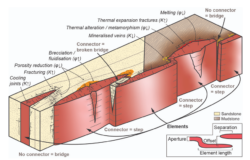
ShIFT will use this information to build novel Finite-Element numerical models that capture sheet-intrusion segmentation and host-rock complexity. We will create synthetic but realistic models that simulate the effect of sheet intrusions on fluid flow in different geological scenarios. Our work will enable a step-change in fluid flow modelling, improving the exploration and management of groundwater and geothermal resources, and storage sites for clean gas, CO2, and radioactive waste.
Project duration: 1 April 2025 to 31 March 2029
Research Team