
Unlocking the UK’s critical minerals potential
In a recent study, researchers at the University of Leeds explored how the UK can unlock its domestic critical minerals sector, identifying the broader foundations needed to support its development.
The UK’s Critical Minerals Strategy aims to strengthen domestic production. However, despite strong geological potential and growing industry activity, the study highlights a range of non-technical barriers that continue to constrain progress.
Drawing on evidence from tin, geothermal lithium and nickel projects in Cornwall and Aberdeenshire, the research shows how these challenges play out in practice.
Barriers beyond geology
Mining companies are well equipped to understand technical risks, such as whether extraction methods will work in a specific location. However, the study finds that non-technical risks often play a decisive role in determining whether projects succeed or fail.
These include mineral rights complexity, planning delays, skills shortages, infrastructure gaps and challenges in community engagement. The regulatory landscape is also highly complex. With no single mining code or unified framework, companies must navigate multiple systems and agencies, creating delays and uncertainty.
Rather than occurring in isolation, these issues accumulate across the project lifecycle, raising costs, increasing uncertainty and making it more difficult to secure investment and progress projects.

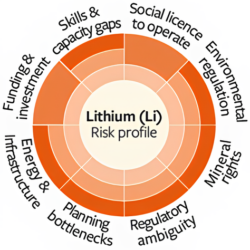
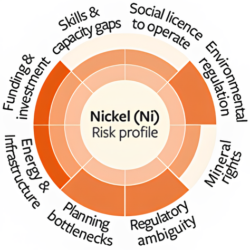
Figure 4. Risk profiles of Tin, Lithium (geothermal) and Nickel
Supporting a responsible sector
Demand for critical minerals is increasing rapidly as the UK transitions to net zero. Developing domestic supply offers an opportunity to strengthen resilience, support economic growth and reduce reliance on imports.

The study emphasises that this must be underpinned by strong governance and environmental safeguards.
High environmental standards and strong public accountability are critical enablers of responsible critical minerals development. Our findings show that progress will require a coordinated commitment from national and local government, regulators, industry, and local communities.
Policy recommendations
To address these barriers, the study calls for a more coordinated and strategic approach. A key recommendation is to develop a clear, coherent national framework to reduce uncertainty and provide consistent guidance for developers and investors.
The research also highlights the need to strengthen planning and regulatory capacity, improve coordination between agencies and provide clearer pathways for emerging technologies such as geothermal lithium extraction.
Targeted financial support for early-stage exploration is essential to help projects progress, alongside investment in infrastructure and domestic processing capacity. Ensuring access to cost-competitive, low-carbon electricity will also be critical to improving the sector’s competitiveness.
Strengthening community engagement is crucial. Early, transparent and meaningful two-way dialogue can help build trust and ensure that projects reflect local priorities and concerns.
A coordinated path forward
With coherent policy frameworks, strengthened planning systems, and transparent engagement approaches in place, the UK can unlock its critical-minerals potential.
This will require coordinated, long-term action from national and local government, regulators, industry and communities.
In doing so, the UK can support its transition to net zero while building a resilient and responsible domestic critical minerals sector.
Interactive model
The project team also developed an interactive tool to bring these findings to life. The model visualises the eight non-technical barriers using a dynamic chart, showing how each barrier manifests across different metals and regions and indicating relative risk levels from low to high. Click on each barrier to explore detailed insights. You can also explore the mining project lifecycle for each metal, with insights into how risks evolve at different stages and the mitigation actions that can support project development.
https://xd.adobe.com/embed/3d8fd180-d37c-4b6c-81ec-0e8dd20b0952-68dc/?fullscreen
Read the full report on the IRC website: https://ircaucus.ac.uk/publications/unlocking-the-uks-critical-mineral-potential-identifying-and-overcoming-non-technical-barriers-in-the-domestic-critical-mineral-sector/