
Shared Ground Loops: A promising path to low-carbon heating
In a recent study, researchers at the University of Leeds highlight the potential of shared ground loops (SGLs) to decarbonise heating in areas where individual heat pumps or heat networks aren’t feasible.
The project has shown that SGLs could work well in low- to medium-density areas and in homes without outside space.
SGLs are a heating system connecting multiple properties to a shared ground loop, usually comprising arrays of borehole heat exchangers. Each property has autonomy over its own heat pump, providing heating and hot water as needed.
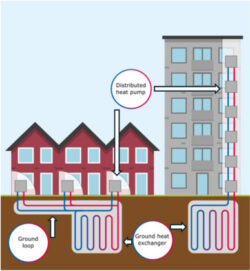
Two SGL systems serving a row of terraced homes and a residential housing block.
The study also suggests SGL systems may be especially suitable in areas further from city centres, where traditional heat networks are less likely to be deployed.
Despite their potential, the research identified several policy gaps that limit the deployment of SGL systems in the UK.
Policy recommendations
The current national heat decarbonisation policy has focused primarily on individual heat pumps and heat networks. As a result, SGLs have not received the same strategic recognition or funding support.
Furthermore, the existing heat pump policy follows an individualised, market-led approach. This includes relying on grants to encourage households and businesses to install their own systems.
However, SGLs function as shared infrastructure, which requires a more coordinated, collective policy framework.
This mismatch between current policy and how SGLs are delivered creates barriers to decarbonising homes, which face difficulties in transitioning.
The study also suggests that local authorities could play a key role in supporting SGL deployment, without national policy intervention. For example, creating a planning system that encourages developers to adopt SGL's technology in new homes could help stimulate the market and support wider uptake.
Practical recommendations
As a shared infrastructure, SGLs require upfront investment and careful coordination. To address this, the study proposes a utility-style business model that spreads costs across multiple users and supports long-term operations and maintenance.
Such models could make SGL systems more financially viable while enabling large-scale deployment.
A closer look at shared ground loops

Illustration of how shared ground loops align with mid-scale deployment between individual heat pumps and heat networks in dense urban centres.
In addition to their suitability for areas where individual heat pumps or centralised heat networks are impractical, SGL systems can offer several advantages.
Some of these include:
- Higher efficiency: SGLs can offer higher efficiencies to homes and buildings where individual ground source heat pumps are not viable
- Improved economic feasibility: SGLs can distribute the cost and complexity of ground infrastructure across multiple homes and buildings
- Reduced peak electricity demand: SGLs can reduce peak electricity demand through access to stable subsurface temperatures, thereby supporting grid load management and enhancing system flexibility
Supporting the transition to net-zero heating
Shared ground loops could play an important part in the transition to low-carbon residential heating. This is especially the case for homes that fall between the typical solutions of individual heat pumps and large-scale heat networks.
With the right policy support, planning frameworks and delivery models in place, SGL systems could help unlock net-zero heating for many communities currently overlooked in the UK.