
Research Spotlight: Lydia Brown
In this blog, our PhD student, Lydia Brown, shares her path into geoscience, her experience at Leeds and abroad. We also look at how her research in offshore wind is supporting the future of clean energy.
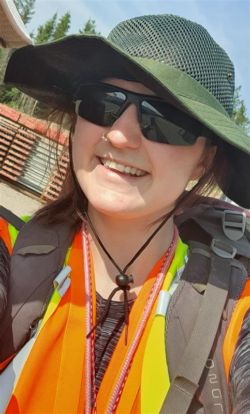
Lydia Brown
Life before Leeds
Lydia began her journey in geoscience with an undergraduate degree in Geology and Petroleum Geology from the University of Aberdeen. She then completed an MSc in Structural Geology and Geophysics from the University of Leeds.
After graduation, she became an onshore geotechnical engineer for a contracting company in West Yorkshire. There she worked on several projects, including flood remediation and railway improvement.
She then travelled through Europe and spent 7 months in Canada working in hard-rock lithium prospecting in Northwest Ontario.
In 2023, she returned to the UK and geotechnical engineering. A year later, she began her PhD at the University of Leeds, working on an offshore wind Joint Industry Project.
'This Joint Industry Partnership offered the opportunity to merge my favourite aspects of both my MSc, remote geophysical data interpretation, and my geotechnical career, soil mechanics and foundation design', shares Lydia.
Time in Leeds
Lydia shares that she enjoyed her time during her MSc at the University of Leeds:
‘The environment was friendly and supportive, and there is a breadth of knowledge within the department, and everyone is keen to collaborate and help.’
According to her, Geosolutions cover a breadth of clean energy solutions. This makes it interesting for someone looking at Quaternary geology for offshore wind design, for example, to learn more about carbon sequestration or geothermal energy.
‘Geosolutions is extremely passionate about clean energy and understands very well both the challenges we face in terms of climate change, and how we, as geoscientists, can help tackle these challenges.’
Supporting the sustainable development of offshore wind
Lydia’s research focuses on advancing 3D ground-modelling workflows to support the sustainable development of offshore wind farms. This JIP project is inspired by the increased demand for offshore wind turbine emplacement in complex geological environments.
Lydia will combine 2D and 3D seismic datasets with geotechnical lab, log, and CPT datasets to create integrated ground models that better map lateral heterogeneity within the subsurface. She will then utilise field data collected from the Isle of Man to investigate lateral heterogeneity at subseismic resolution and use this as an analogue for Dogger Bank.
'Working within a JIP has been extremely helpful with this, as I have access to industry professionals in all fields of the offshore wind industry. Attending conferences has enabled me to build valuable connections and understand different perspectives and what each role requires of a ground model.'
Future ambitions
Lydia chose to pursue this PhD because she thought it was an amazing opportunity to conduct scientific research in a field she loves.
'One thing my career has taught me is that you cannot set plans too clearly in life and honestly, I am excited to see what opportunities present themselves throughout and after my studies, but I won’t attempt to predict what they might be!'