
Research Spotlight: Dr Lynn Wray
Dr Lynn Wray recently joined Geosolutions Leeds as part of the ‘Stories from the Subsurface’ project.
She is a practice-based researcher and creative practitioner focused on exploring how collaborative creative methods can be used to understand better and tell stories about complex phenomena, ranging from technological and political processes to environmental and social justice issues.

Dr Lynn Wray
Exploring Complexity Through Creative Practice
Dr Wray’s passion for exploring how art can connect us to specific places and environments led her to pursue a BA in Environmental Art, where she enjoyed experimenting with different media and creating site-specific artworks that explored the histories, stories and sensory experiences of amateur athletics events, swimming pools, hospital waiting rooms and libraries.
Following this, she completed a two-year MA at the Royal College of Art, where she focused on using photography, sequential drawing, and book design to communicate contentious historical narratives.
After a period of self-employed creative practice, Wray’s career turned towards exhibition-making and museum- and gallery-based collaborative and participatory research. She undertook a collaborative Doctoral Award in Curatorial Practice, hosted by Tate Liverpool and sponsored by Liverpool John Moores University, where she curated a major international exhibition, Art Turning Left: Putting Political Values into Practice 1789-2013 (Tate Liverpool,2013-2014). This exhibition focused on how leftist artists had attempted to put their political principles into practice through the way they made, exchanged, and distributed their work.

Credits: Dr Lynn Wray, Art Turning Left
After completing her PhD in 2016, she worked as a Project Curator at National Museums Liverpool and as a lecturer in curatorial practice at LJMU.
My career journey, like that of most creatives and practice-based researchers, hasn’t been a linear or typical academic career path, but it has never been boring either.
Learning through Making: Creative Practice as Research Inquiry
The most important tenet of Dr Wray’s research is that creative making is a way of thinking, learning, analysing, and critically reflecting—of actively doing research, not just disseminating research findings. In 2017, Dr Lynn Wray took up the role of Researcher on the Bradford National Museum project, based jointly at the University of Leeds and the National Science and Media Museum in Bradford.
The project focused on strengthening the connections between communities, Bradford, and the museum. As part of the project, she led the co-curation of the exhibition ‘Above the Noise: Fifteen Stories from Bradford (National Science and Media Museum, March- June 2019).
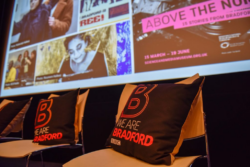
Credits: Dr Lynn Wray, Above the Noise
The exhibition presented stories about how communities had bypassed or confronted mainstream media narratives and/or developed their own methods of making and distributing stories.
The making of the exhibition was a critical part of a participatory action research process aimed at better understanding how the museum could work more collaboratively with communities in Bradford and write more Bradford narratives into the museum’s public-facing work.
Similarly, as Co-Investigator on Communities and Crowds with The Science Museum, she worked with members of the local community and the Zooniverse teams at the Adler Planetarium in Chicago and at Oxford University to develop an online citizen-science research project investigating the experiences of African-Caribbean migrants to Britain in the Post-war period. Here, the development of the citizen science project was not an endpoint of the research process but rather an action research inquiry into how online and in-person processes could be integrated into the development of museum and archive crowdsourcing projects.
As part of her next role as Research Fellow in Creative Development and Documentation for the interdisciplinary LivingBodiesObjects project, Wray focused her practice-based research on exploring how sequential drawing might be used to communicate the research journey, as a reflective tool for collective analysis and for the creation of compelling visual and digital stories for environmental and health justice campaigns.
Stories from the Subsurface
Wray was drawn to work on Stories from the Subsurface because it involved a challenge similar to that in her previous work: how to engage the public and policymakers in environmental issues that are both complex and largely unseen. She explains why she was excited to work with Geosolutions Leeds:
In subsurface research, the processes and impacts are not visible to us, primarily because they happen beneath the Earth’s subsurface. Yet the potential benefits of building public support for more investment in net-zero subsurface activities are immense for everyone.
The project aims to explore how to tell effective stories about the subsurface that can engage audiences in the energy transition. It will involve collating, analysing, and evaluating current best practices in evidence-based science and environmental storytelling through a combination of interviews, a literature review, and appreciative inquiry.
The learning from this will inform the co-creation of three stories with the Geosolutions team about their subsurface activities.
Within this project, my personal aim is to use practice-based research to develop new creative methods for visualising the hidden and complex processes, to communicate the subsurface as a dynamic space of positive potential and to keep audiences engaged by finding new ways to counter the demands of the attention economy.