
Research Spotlight: Dr Esme Glastonbury-Southern
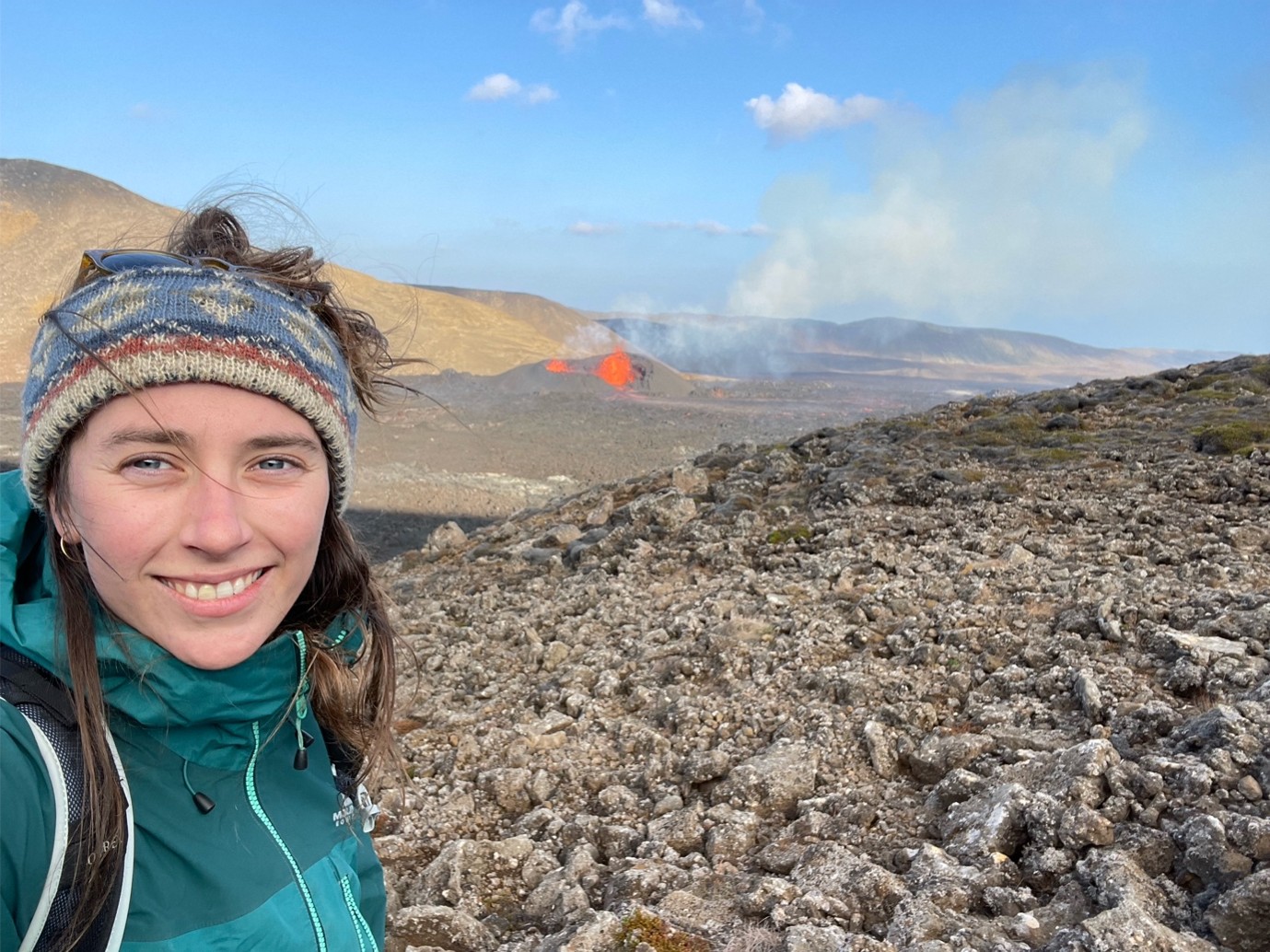
This research spotlight shares Dr Esme Glastonbury-Southern’s journey in geoscience. Her love of geophysics led her from studying volcanoes in Iceland to conducting geothermal research in Leeds. Esme’s work is helping to improve our understanding of geothermal systems and is supporting the move toward cleaner, more sustainable energy for the future.
First Steps in Geoscience
Esme began her geoscience journey with an undergraduate degree in Natural Sciences at the University of Cambridge. She initially intended to specialise in Physics, but after a turbulent start, she realised that pure Physics wasn’t the right fit for her:
Earth Sciences was far more exciting!
In her fourth year, Esme chose a research project in seismology, investigating the earthquakes associated with the Icelandic volcano Bárðarbunga. The project took her to Iceland for her first fieldwork, where she serviced a seismic network in the remote Highlands. It was a pivotal moment that sparked a fascination with both seismology and Iceland that has stayed with her ever since.
For me, this was when I really felt like I’d made the right decisions, and Geophysics provided the perfect blend of the science I enjoyed with important, real-world, fascinating applications.
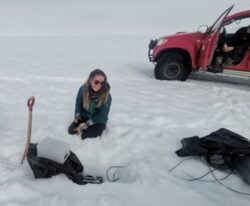
Deployment of a seismic network above Bárðarbunga volcano on the Vatnajökull glacier, Iceland
After completing her integrated Master’s degree, Esme remained in Cambridge to undertake a PhD within the same research group. She studied the seismicity associated with magma moving underground before the most recent volcanic eruptions on Iceland’s Reykjanes Peninsula.
My PhD couldn’t have been a more exciting and wonderful experience, and I was so lucky to be guided by excellent supervisors.
During her doctorate, she witnessed two volcanic eruptions on the Reykjanes Peninsula, crossed rivers in the Highlands, survived a vehicle falling into a crevasse on the Vatnajökull glacier, endured severe seasickness during an ocean-bottom seismometer deployment off the south coast, and much more.
I fell completely in love with the place and the work I was doing to understand the subsurface processes that make Iceland so unique.
Dr Esme Glastonbury-Southern; second eruption at Fagradalsfjall, Reykjanes Peninsula, Iceland in August 2022
Discovering Geothermal Energy
During the third year of her PhD, Esme completed a three-month internship at Cornish Lithium as part of their Lithium in Geothermal Waters team. She worked on several projects, including investigating seismicity in southwest England, extracting and analysing data from old mine plans, developing 3-D subsurface models to support geothermal/mining exploration, and studying fractures in bathymetric datasets.
Time in Leeds
Esme joined Geosolutions Leeds and the School of Earth, Environment and Sustainability as a Research Fellow on the project Testable geophysical and geological models from probabilistic imaging in early 2026.
My current role combines everything I loved about my PhD and the geothermal industry I became interested in during my internship.
In Leeds, Esme applies many of the geophysical techniques she developed during her PhD to geothermal systems. This allows her to learn more about the geothermal industry and how her work can inform and de-risk decision-making during geothermal exploration.
I’ve learned so much since arriving in Leeds. It’s been great to get new perspectives, meet new people, and be part of a new team with such broad experience.

Hengill nodal seismometer deployment. From left to right, field assistants Aude Lepere and Cécile Driou, myself in hi-vis, and Brandon VanderBeek. Photo taken by Franck Latallerie.
Exploring the heat beneath our feet
In her current role, Esme is using a seismicity dataset from the Hengill region in southwest Iceland to understand subsurface fracture networks. She uses a technique called shear-wave splitting, which enables scientists to study seismic anisotropy in the crust.
Understanding fluid permeability within the crust is critical for geothermal companies operating in the region. By combining surface observations with borehole logs and surface fracture mapping, the project aims to improve the understanding of the fracture networks that influence permeability.
The initial results from the first phase of the research in Leeds are exciting. The team has made some interesting observations of crustal seismic anisotropy, finding it variable across the area. The shear-wave splitting results likely reflect the orientation of subsurface features such as fractures and faults, so the team has compared them with mapped surface fracture datasets and borehole logs for the area.

Hengill node site, photo of Dr Esme Glastonbury-Southern taken by Dr Brandon VanderBeek
Where borehole data is available, the team’s observations of crustal anisotropy align well with the fracture orientations noted in those logs. In many places, anisotropy measurements also align with surface mapping, but in certain places where borehole data are absent, the team sees a mismatch. These findings highlight the challenge of inferring subsurface conditions from surface observations alone.
Sometimes, you don’t really know whether what you see at the surface is going to match the subsurface until you drill a hole – that is, unless you make measurements like ours.
Shear-wave splitting is therefore a valuable technique to apply to data you can record at the surface, using seismic waves from earthquakes to passively sample the crust between the earthquakes and the seismometers that record them.
Looking ahead
Esme hopes the research will improve the characterisation of future geothermal targets using a relatively non-invasive technique that can be applied to datasets that may already exist for certain regions or, if not, are relatively easy to create through passive seismic monitoring.
Geothermal is a clean energy source that could really help us forge ahead with the energy transition.
Iceland is a fantastic place to study this because it's a world leader in the field and has been producing energy this way for a long time.
I hope research like this can serve as an example and be applied in other areas worldwide where geothermal could also be a clean energy solution.
Esme is also looking forward to combining her research at Hengill with that of former Geosolutions researcher Brandon VanderBeek, who used seismic P-waves to investigate seismic anisotropy in the region, and to see whether a joint inversion of P- and S-waves can improve and build on the work we’ve been doing separately so far.