
Grounded Engagement: Community stories and mining in Cornwall
An interdisciplinary research team from the University of Leeds held a three-day workshop from 3 to 5 June in Redruth, Cornwall. The event brought together community organisations, industry representatives, geologists, academics, educators and creative practitioners. Through a combination of discussion workshops, guest talks and participatory filmmaking activities, participants explored what meaningful engagement looks like in the early stages of mineral exploration and what lessons can be learned for stakeholder engagement in extractive industries more broadly.
Cornwall has experienced a mining boom in recent years driven in part by growing interest in critical minerals for the energy transition. Therefore, Redruth provided an ideal setting for participants to reflect on current experiences of mineral exploration and discuss wider questions of participation, communication and trust in extractive industry projects.
The event started with talks by Dr Emma Wilson (Director, ECW Ltd.), representatives from Cornish Metals, Dr Ursula Balderson (University of Leeds), and Dr James Van Alstine (Geosolutions Leeds, University of Leeds). They shared practical experience and research from both the UK and abroad to encourage discussion.

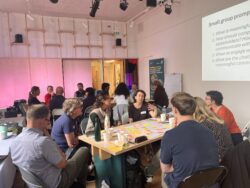
- Engagement must begin early: Trust develops well before any formal consultation. Having early conversations and building relationships lay the groundwork for meaningful engagement as the project moves forward.
- Stakeholder engagement should be a two-way process: Engagement is not the same as communication. Communication shares information; engagement creates opportunities for dialogue, influence and mutual learning.
-
Communication should be accessible and relevant for the local context: Communities want to be heard, not simply informed. Using multiple approaches to create spaces for open discussion is often more effective than relying only on presentations or formal consultation events.
- A wider range of voices needs to be included: Communities have diverse interests, identities and experiences, so engagement approaches need to reflect this diversity.
- Meaningful engagement should not be left to industry alone. Government, local authorities, community organisations and industry all have a role to play.
- There is a role for open and inclusive public debate: Questions concerning public priorities, environmental responsibilities, land use and the distribution of benefits and impacts should be matters of public debate.
One of the most exciting parts of the workshop was experimenting with participatory filmmaking as a tool for dialogue and communication. Through film, people can tell stories in their own words and from their own perspectives. These stories have the potential to reveal experiences, values, hopes and concerns that may not be captured through more conventional approaches to engagement.
Participants took part in hands-on sessions, using film to capture and share their own experiences and perspectives on mining and community engagement.

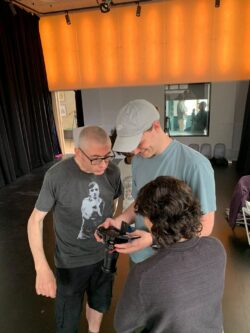
Over the coming months, the research team will continue to work with participants to develop these short films, which will be showcased at a public screening in Redruth in autumn 2026.
Interested in the project? Read the full workshop report or get in touch.
Learn more about the Grounded Engagement project and the Stories from the Subsurface project.
You can read a blog about lessons from the Swedish case.
This project forms part of an interdisciplinary collaboration, bringing together geologists (e.g., Dr Taija Torvela), social scientists (e.g., Dr Laura Smith, Dr Rory Padfield, Maria Radeva) and creative practitioners (e.g., Prof Paul Cook, Dr Lynn Wray).